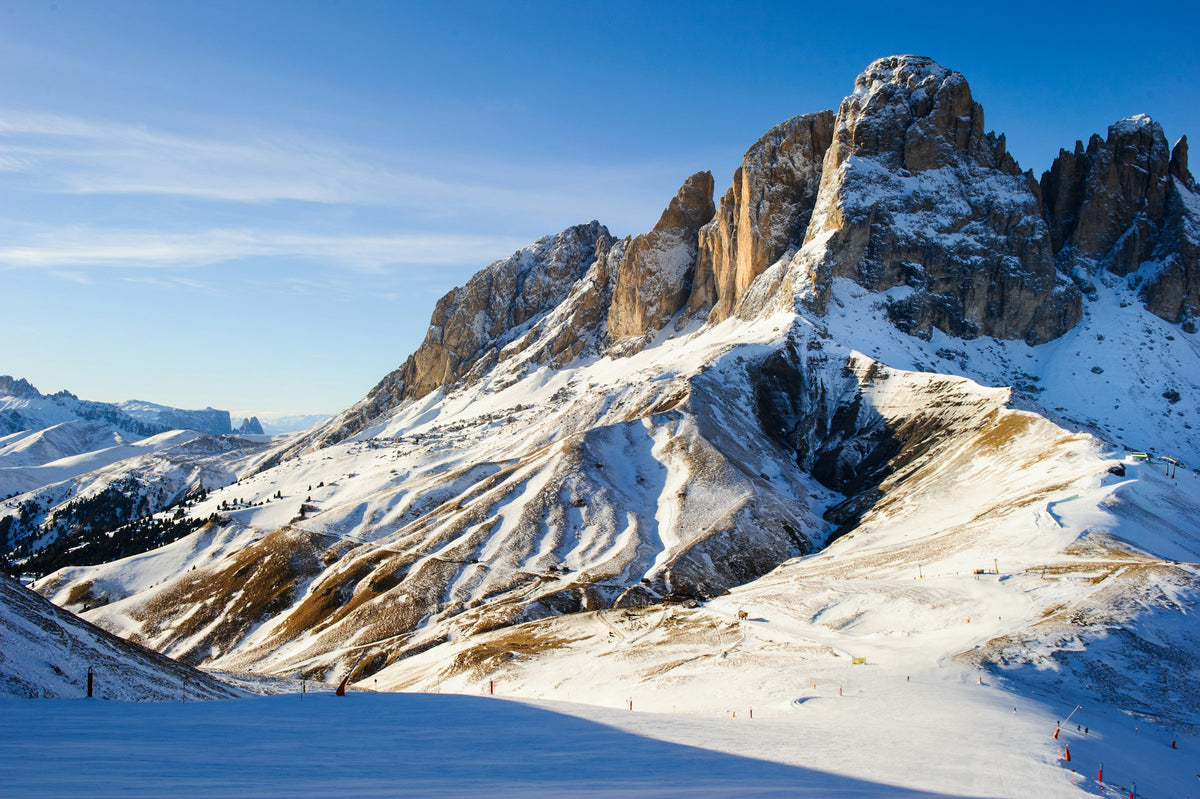
8-Day Cinque Torri to Val Gardena Explorer Ski Safari in the Dolomites

8-Day Cinque Torri to Val Gardena Explorer Ski Safari in the Dolomites

Skip to product information
1 of 5
View full details

Itinerary

Day-by-Day Itinerary

What's Included

Getting There

Stay & Meals

Day-by-day itinerary

Day 1: Arrive in Cortina d'Ampezzo
Skiing: none | Overnight: 4-star hotel in Cortina

Arrive at your own pace and check in. If you are early, the center is a short walk: collect rental gear and your lift pass, then wander Corso Italia with the Tofane closing off the view.

Day 2: Tofane Ski Area
Skiing: Tofane, Cortina | Overnight: 4-star hotel in Cortina

A full day on the Tofane, the mountain that hosted World Championships, World Cup races and the women's alpine events of the 2026 Winter Olympics. Wide, freshly groomed runs low down to warm up; the Canalone and the Tofane Schuss higher up. The Freccia nel Cielo cable car climbs to Ra Valles at 2,745 m (9,006 ft), where the snow holds all season. Lunch on a hut terrace above the Cortina basin.

Day 3: Faloria-Cristallo and Cinque Torri
Skiing: Faloria-Cristallo, Cinque Torri | Overnight: rifugio at the Cinque Torri

Morning on the far side of the valley: Faloria, whose first cable car dates from 1939, and the red and black runs of Cristallo, with the Vitelli as the signature descent. Around midday you ski back to Cortina, cross to the Tofane and ride the new cable car to the Cinque Torri. The afternoon is spent among the towers with Averau, Nuvolau and Lagazuoi all around. Hot dinner and a night in the hut. Your bag travels separately.

Day 4: Armentarola and the Marmolada glacier
Skiing: Lagazuoi, Alta Badia, Arabba, Marmolada | Overnight: rifugio below the Marmolada

The longest and best day. Cable car to Rifugio Lagazuoi, then the Armentarola: a long descent between Dolomite walls and forest that ends with a horse-drawn sled tow to the edge of Alta Badia. Wide sunny runs to Passo Campolongo, a steeper drop into Arabba, then Malga Ciapela. Gondolas carry you to Punta Rocca, 3,265 m (10,712 ft), the high point of the tour. Finish on the Bellunese along the glacier down to the hut. Luggage transferred.

Day 5: Val di Fassa to Val Gardena
Skiing: Marmolada, Canazei-Belvedere, Passo Sella | Overnight: 4-star hotel in Val Gardena

Early start for one untracked run on the Marmolada. Then the Sellaronda leads to Passo Pordoi and the Canazei pistes, linked to the Buffaure area if you want a few harder reds. At Passo Sella the view of the Sella towers and the Sassolungo is the best of the day. The Città dei Sassi run, threading through boulders fallen from the Sassolungo, drops you into Val Gardena. Luggage transferred.

Day 6: Discovering Alta Badia
Skiing: Alta Badia (130 km / 81 mi of pistes) | Overnight: 4-star hotel in Val Gardena

Private transfer to Passo Gardena and a full day in Alta Badia: 130 km of pistes groomed every night by more than 90 snowcats. Colfosco and its huts, the plateau above Corvara, the Piz Boè cable car toward the Sella and, if you like, the Gran Risa, the World Cup black. The huts here double as gourmet tables, so plan a long lunch. Late afternoon return to Val Gardena.

Day 7: Gardenaronda
Skiing: Val Gardena and Alpe di Siusi | Overnight: 4-star hotel in Val Gardena

Last day on the circuit linking Santa Cristina, Selva and Ortisei. Open on the Saslong, the World Cup downhill course, then ride the Val Gardena Ronda Express train to Col Raiser under the Odle. The black Pela, one of the steepest in the valley, is optional. From Ortisei go up to the Alpe di Siusi, Europe's largest high plateau, for easy runs with views of Sciliar and Sassolungo. A short bus to Monte Pana and final turns on Ciampinoi.

Day 8: Departure
Skiing: none | Overnight: —

Breakfast, check-out and onward travel. If your car is in Cortina, the public transport link is simple; timetables are in the roadbook.

The program may change for snow or weather at the discretion of the team on the ground or the ski guide, keeping the structure and goals of the tour.

What's Included

Tour formats

Self-guided: you ski independently with a day-by-day roadbook, maps, hotels and huts already booked, luggage transfers and a 24-hour support line. Ideal if you know the Dolomites or enjoy navigating.

Private guided: the same itinerary with a ski guide dedicated to your group, who sets the order of the runs around snow, weather and legs, and knows the right huts for lunch.

Included

  • 2 nights in a 4-star hotel in Cortina d'Ampezzo, double or triple room
  • 2 nights in a mountain hut, shared room with shared bathroom
  • 3 nights in a 4-star hotel in Val Gardena, double or triple room
  • Half board throughout
  • 6-day Dolomiti Superski lift pass
  • Private transfer on day 6
  • Luggage transfer on days 3, 4 and 5
  • Maps and trip documentation
  • 24-hour assistance
  • Private guided: ski guide on all ski days

Not included

  • Tourist tax in hotels and huts where applicable
  • Drinks and extras
  • Solo traveler supplement
  • Private room in the huts: € 20 per person per night, on request
  • Public transport back to the start: about € 15
  • Ski rental, available on request
  • Ski/snowboard insurance (mandatory)
  • Cancellation and medical/baggage insurance
  • Anything not listed

Prices per person, departures January 9 to March 27, 2027

  • Self-guided, 2 participants: € 4,600 per person
  • Self-guided, 4 participants: € 4,250 per person
  • Self-guided, 6 participants: € 4,200 per person
  • Private guided, 2 participants: € 7,850 per person
  • Private guided, 4 participants: € 5,950 per person
  • Private guided, 6 participants: € 5,400 per person

Hotels and huts may be replaced by other categories on request or when necessary, with the price adjusted. Availability on request.

Getting to the start

Start: Cortina d'Ampezzo (Belluno province), 1,224 m (4,016 ft). End: Val Gardena (Selva, Santa Cristina or Ortisei).

By air. Venice Marco Polo (VCE) is the closest and most convenient: about 2 hours by car or shuttle to Cortina. Innsbruck (INN) is about 2 h 30, Verona (VRN) about 3 h, Milan Malpensa (MXP) about 4 h 30. For the return from Val Gardena, Innsbruck is about 1 h 45 and Venice about 2 h 45. From the US, connections through Munich, Frankfurt, Zurich or Rome into Venice are the usual route.

By train. The nearest station to Cortina is Calalzo di Cadore, linked by bus in about an hour; Dobbiaco on the Val Pusteria line also has buses to Cortina. On the way home, buses run from Ortisei to Bolzano in about an hour, with trains onward.

By car. The route is point-to-point, so the car stays in Cortina; we point you to parking. Public transport back from Val Gardena is cheap and described in the roadbook, or ask us for a private return transfer.

Arriving early. Plan to reach Cortina by the afternoon of day 1 to collect your pass and any rental gear. Coming straight off a transatlantic flight, an extra night in Cortina is worth it; we can add it.

Insurance & Visas

Insurance. A ski/snowboard policy covering on-piste rescue, ambulance or helicopter transport and medical expenses is mandatory and not included; buy it at the lift-pass office or through an annual policy before you travel. We also strongly recommend trip cancellation and medical/baggage cover: dates are on request and a problem before departure can be costly. US travelers should check that their policy includes helicopter evacuation abroad.

Documents. EU citizens: valid ID card. Swiss and UK citizens: passport. Travelers from the United States, Canada and Australia: passport valid at least three months beyond your return date, no visa for stays up to 90 days in the Schengen area. Check the current status of the EU's ETIAS travel authorization before you fly.

Accommodation

Night by night

  • Nights 1 and 2: 4-star hotel in Cortina d'Ampezzo, double or triple room with private bathroom
  • Night 3: rifugio in the Cinque Torri area, shared room with shared bathroom
  • Night 4: rifugio at the foot of the Marmolada, at the tree line, shared room with shared bathroom
  • Nights 5, 6 and 7: 4-star hotel in Val Gardena, double or triple room with private bathroom

The hotels are chosen for location and for comfort after a long day: a sauna or wellness area, heated ski room, generous breakfast. The two huts are winter-open, heated mountain refuges reached by lift, where you literally sleep on the piste.

Private hut rooms are available on request for a small per-night supplement. A single supplement applies in the hotels if you travel alone.

Meals

Half board for all seven nights: breakfast and dinner included, lunches on the mountain at your own pace.

Hotel breakfasts are buffet, sweet and savory; dinner is served, usually three or four courses with a choice between Ampezzo and Ladin dishes and lighter options. In the huts dinner is a set, hot, generous menu: soup or pasta, a main with sides, dessert. Breakfast is simple but enough to get going.

Lunch is where the Dolomites shine: mountain huts across Dolomiti Superski serve canederli (bread dumplings), polenta with sausage, casunziei (beet ravioli), apple strudel and espresso with a view. In Alta Badia several huts run gourmet kitchens; booking is worth it.

Allergies, intolerances, vegetarian or vegan diets: tell us when you book and we pass it to hotels and huts. Hut options are simpler but available.

Pista da sci soleggiata in Val Gardena con le Dolomiti sullo sfondo
Sciatori sulla pista del ghiacciaio della Marmolada, Canazei
Le Cinque Torri innevate sotto il cielo blu, Cortina d'Ampezzo
La Marmolada, Regina delle Dolomiti, con il ghiacciaio innevato in pieno inverno
Pistes
Difficulty
Stay
Crowds

Pistes & ski areas

Tofane (Cortina): wide, immaculately groomed runs in the lower sector; the Canalone and the Tofane Schuss up high. Ra Valles at 2,745 m (9,006 ft) has reliable snow all season. Modern lifts, extensive snowmaking. These are the Olympic slopes of Cortina 2026.

Faloria-Cristallo: a scenic, quieter sector with reds and blacks for confident skiers; the Vitelli is the classic descent.

Cinque Torri and Lagazuoi: sunny runs between the rock towers, then the Armentarola: long, not steep, cinematic, with the horse-sled tow on the flat finish.

Alta Badia: 130 km (81 mi) of pistes groomed nightly by 90-plus snowcats, a broad easy plateau, and the Gran Risa black for those who want it.

Arabba and Marmolada: the steepest sector of the Sellaronda, then gondolas to Punta Rocca (3,265 m / 10,712 ft) and the Bellunese, a long glacier run.

Val di Fassa and Passo Sella: varied terrain at Canazei-Belvedere, a link to Buffaure, then the Città dei Sassi toward Val Gardena.

Val Gardena and Alpe di Siusi: the Saslong World Cup downhill, Col Raiser beneath the Odle, the Pela black, and gentle groomers on the plateau. Run colors are European: blue/red/black roughly maps to green/blue/black in US terms.

Difficulty factors

What makes this ski safari demanding, in practice:

  • Long link-up days. Day 4 covers Lagazuoi, Alta Badia, Arabba and the Marmolada: you need to keep a rhythm and respect lift closing times.
  • Reds in sequence, short blacks. Arabba, Cristallo and the Canalone need solid technique. Pela and Gran Risa are optional.
  • Variable snow up high. On the Marmolada and at Ra Valles the surface can be firm in the morning and soft by afternoon.
  • A new ski area every day. Reading the piste map and navigating matters, especially self-guided.
  • A pack on your back. On days 3, 4 and 5 your luggage travels ahead, but your overnight kit for the hut rides with you.

Hotels & mountain huts

The 4-star hotels in Cortina and Val Gardena deliver what you expect at that level: en-suite rooms, heating, a ski room with boot dryers, and often a sauna or small spa. They sit in the village or near the lifts, so evenings are on foot.

The winter rifugi (mountain huts) are a different thing, and that is the point. Shared rooms with single or bunk beds, duvets and pillows provided, bathrooms and hot showers down the hall. Electricity and heating, yes; Wi-Fi may be slow or absent and cell signal is not guaranteed. Bring a power bank, a light sleeping-bag liner (some huts require one), slippers and earplugs.

The payoff is real: in the evening the Cinque Torri or the Marmolada are yours alone, and in the morning you are first on freshly groomed corduroy.

Crowds & quiet corners

The Dolomites in winter are popular, but this tour crosses each area at times and in directions that help.

Periods. The busiest weeks are Carnival (mid-February) and sunny March weekends. January after Epiphany and the first two weeks of March are quieter on the slopes and in the hotels. Presidents' Day week is not a factor here.

Areas. The Tofane and Alta Badia have high-capacity lifts and lines clear quickly. The Armentarola is famous and fills up mid-morning: taking the first cable car from Lagazuoi makes all the difference. Faloria-Cristallo and Buffaure are often nearly empty.

Quiet corners. The two hut nights give you the first hour on the pistes at the Cinque Torri and on the Marmolada with nobody around. The Alpe di Siusi on the last day is wide and silent even on weekends.

Pista da sci soleggiata in Val Gardena con le Dolomiti sullo sfondo
Sciatori sulla pista del ghiacciaio della Marmolada, Canazei
Le Cinque Torri innevate sotto il cielo blu, Cortina d'Ampezzo
La Marmolada, Regina delle Dolomiti, con il ghiacciaio innevato in pieno inverno
18 shield check

Ask the Dolomist Team

A ski safari deserves the right choice. We're here to help you make it.

Talk to an Expert

18 target

Reply within 24 hours

18 target

Local mountain experts

18 target

Tailored experiences

Request Now

FAQ

Safety

Insurance & Visas

Safety on the slopes

You ski on marked, groomed pistes of Dolomiti Superski, with piste rescue on duty in every area. The single emergency number in Italy is 112.

  • Follow the FIS rules of conduct and lift closing times: on link-up days start early to keep a margin.
  • Helmets are recommended for everyone and mandatory under 18 in Italy.
  • Ski/snowboard insurance is mandatory and not included: it covers on-piste rescue, transport and medical costs. Buy it with your lift pass or through your own policy.
  • In the Private guided format the ski guide chooses routes and timings for the conditions and stays with you all day.
  • In the self-guided format you have a 24-hour support number and a roadbook with alternative plans.
  • No off-piste skiing is planned. If you want to add a guided freeride day with a mountain guide, ask us.

Clothing & Gear

On hut nights you ski with a 20-25 liter daypack holding your overnight kit; the rest of your luggage travels ahead.

  • Layers: thermal base layer, fleece or light down midlayer, waterproof-breathable ski jacket and pants
  • Extremities: warm gloves plus a spare pair, neck gaiter, beanie for evenings, ski socks
  • Head and eyes: helmet, goggles with a sunny-day lens and a flat-light lens, sunglasses, high-SPF sunscreen
  • For the huts: light sleeping-bag liner, slippers, earplugs, power bank, small toiletry kit, one light change of clothes
  • Useful: water bottle, snacks, blister plasters, ID and lift pass on you at all times

Rental. Skis, boots, helmet and poles can be rented in Cortina on request; the gear stays with you for the tour and is returned in Val Gardena. Give us your height, weight and level when you book. Flying with your own skis from the US is fine too; most airlines count a ski bag plus boot bag as one checked item. A full packing list comes with your trip documents.

Weather & Snow in the Dolomites

Between January and March the Dolomites have a continental alpine climate: valley temperatures from about 18 to 41 °F (-8 to +5 °C), down to 5 °F (-15 °C) with wind up high. Clear days are the norm, and the low winter light lights up the Dolomite walls at sunrise and sunset.

Snow. Dolomiti Superski has near-total snowmaking coverage and pistes are groomed every night. Ra Valles and the Marmolada, above 2,700 m (8,860 ft), have reliable snow all season. In March the surface turns to spring snow by afternoon: start early and ski shaded aspects after lunch.

Altitude. From 1,224 m (4,016 ft) in Cortina to 3,265 m (10,712 ft) at Punta Rocca. Bring high-SPF sunscreen even in January; glare at altitude is strong.

Heavy snowfall or high wind can close some link lifts: the team on the ground or your ski guide reworks the day.

Insurance & Visas

Insurance. A ski/snowboard policy covering on-piste rescue, ambulance or helicopter transport and medical expenses is mandatory and not included; buy it at the lift-pass office or through an annual policy before you travel. We also strongly recommend trip cancellation and medical/baggage cover: dates are on request and a problem before departure can be costly. US travelers should check that their policy includes helicopter evacuation abroad.

Documents. EU citizens: valid ID card. Swiss and UK citizens: passport. Travelers from the United States, Canada and Australia: passport valid at least three months beyond your return date, no visa for stays up to 90 days in the Schengen area. Check the current status of the EU's ETIAS travel authorization before you fly.